
Vision
Our lack of understanding of basic mechanisms underlying autoimmune disease aetiology prevents the development of successful management strategies for patients’ benefit.
Genetic studies of the Human Leucocyte Antigen (HLA) system suggest a central role of peptide autoantigens in the initiation and maintenance of autoimmune diseases.
The Disease
Our main research focus is on rheumatoid arthritis, a systemic autoimmune disease affecting predominantly the small joints of hands and feet. Rheumatoid arthritis is characterised by pain, systemic inflammation, decreased quality of life and increased mortality. Presentation of citrullinated autoantigenic peptides by Antigen Presenting Cells (APCs) to CD4⁺ T cells is hypothesised to be play a central role in the disease process.
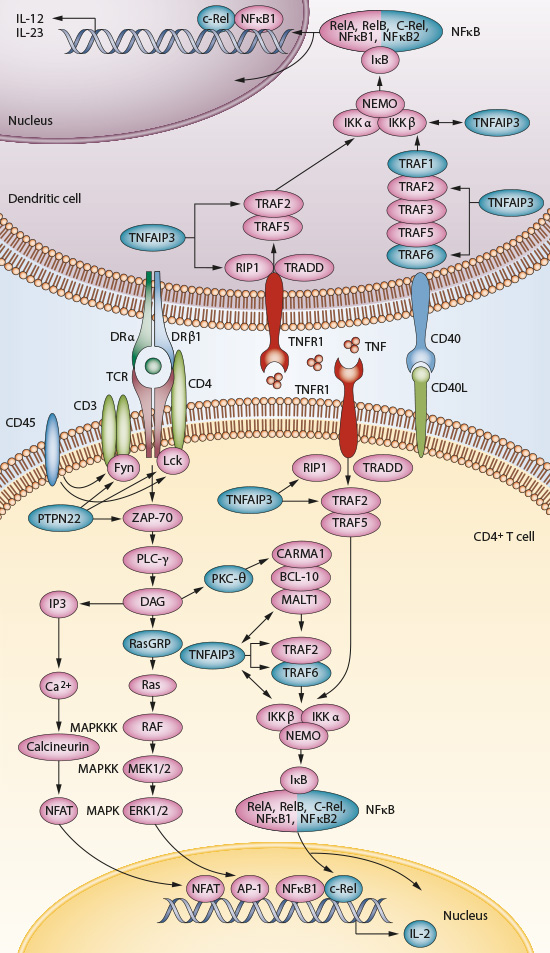
Viatte S, Nat Rev Rheumatol, 2013
?

Understanding disease mechanisms underlying genetic associations with rheumatoid arthritis
Phenotype and function of anti-citrulline CD4⁺ T cells in different anatomical compartments and different disease stages
Genetic mapping: identify immune cell states and intracellular pathways under the control of rheumatoid arthritis genetic susceptibility polymorphisms
Identification of genetic and cellular classifiers for precision medicine in rheumatoid arthritis
Genetic pleiotropy: identification of shared and unique genetic markers underlying susceptibility and prognosis/outcome in rheumatoid arthritis and their overlap with other autoimmune diseases
Immunophenotyping programme of myeloid and lymphoid cell subsets by mass cytometry across anatomical compartments to identify immune signatures of clinical relevance
Genetic associations of rheumatoid arthritis susceptibility, severity and response to treatment
Rheumatoid arthritis (RA) comprises two serological subtypes, anti-citrullinated peptide antibody negative and positive RA; we contributed to show that these disease subtypes are genetically different. Some genetic markers are shared, while others are specific to one serotype only (Viatte, Ann Rheum Dis, 2012; Eyre, Nat Genet, 2012; Viatte, Arthritis Rheumatol, 2016).

Single Nucleotides Polymorphisms (SNPs) associated with rheumatoid arthritis susceptibility can be classified into different categories based on their differential association with seronegative and seropositive rheumatoid arthritis (Viatte, Ann Rheum Dis, 2012).
Using and further developing longitudinal modelling techniques of radiographic outcome in RA, the Viatte Lab identified or replicated several genetic markers of disease severity outside the HLA (CARD9 in Sharma, Ann Rheum Dis, 2025; FOXO3A in Viatte & Lee, Arthritis Rheumatol, 2016 and in Lee, Cell, 2013; TRAF1 in Viatte, J Rheumatol, 2013). We were the first lab to show that the strongest genetic association with radiographic outcome in RA across the entire genome is the carriage of the amino acid valine at position 11 of HLA-DRβ1 (Viatte, JAMA, 2015). We used Generalized Linear Latent And Mixed Models (GLLAMMs) to incorporate multiple records per patients over time in one statistical model to predict non-normally distributed measures of disease outcome. Interestingly, in contrast to genetic associations outside the HLA, or in contrast to other autoimmune diseases, we managed to show that, within the HLA, associations with RA susceptibility are the same as associations, and this with multiple measures of RA severity (or prognosis, outcome – Sharma, Arthritis Res Ther, 2022; Ling & Viatte, Arthritis Rheumatol, 2016; Viatte, JAMA, 2015).
Cellular mechanisms underlying genetic associations with disease
This programme of work is ongoing – in preliminary data analysis of mass cytometry datasets, we have shown the superiority of agnostic approaches (automated clustering) over manual gating to identify cellular signatures of rheumatoid arthritis in peripheral blood in small sample sizes (Mulhearn & Marshall, Front Immunol, 2023).
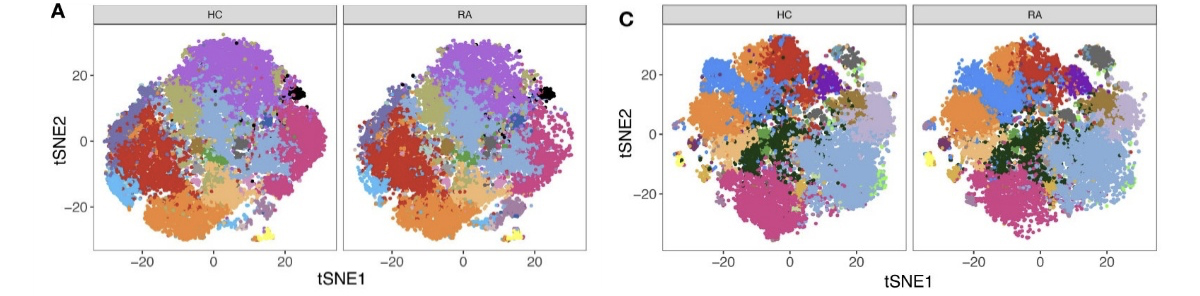
Definition of cellular clusters (T lymphocyte states) by mass cytometry and FlowSOM in healthy individuals (HC) and patients with rheumatoid arthritis (RA) before and after stimulation of the TCR signalling pathway.
Mulhearn & Marshall, Front Immunol, 2023
Clinical translation and precision medicine
Genetic haplotypes defined by HLA-DRB1 positions 11/13, 71 and 74 classify patients into different prognostic categories (Viatte, JAMA, 2015), however, the predictive capacity of the same position does not seem to be sufficient to guide any clinical decision for treatment with TNF inhibitors or abatacept (Jiang, Arthritis Res Ther, 2016; Yap, Arthritis Rheumatol, 2025).
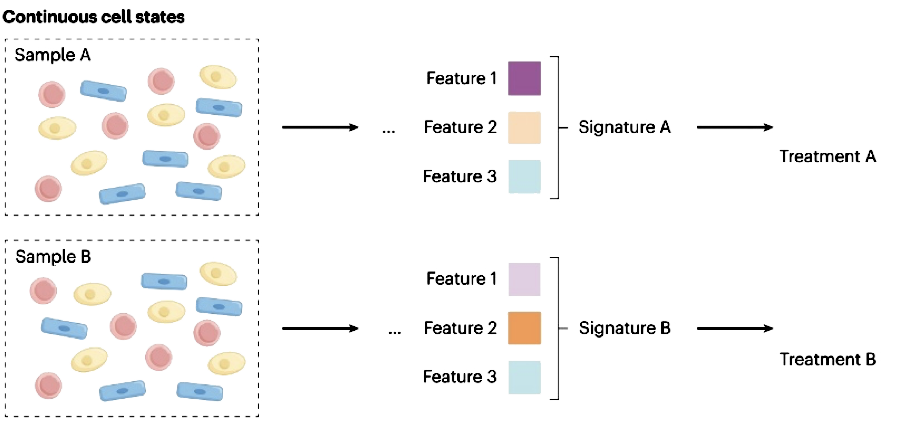
We are developing methods to test the association of immune cell composition with clinical outcomes for precision medicine.
Marshall, Nat Rev Rheumatol, 2025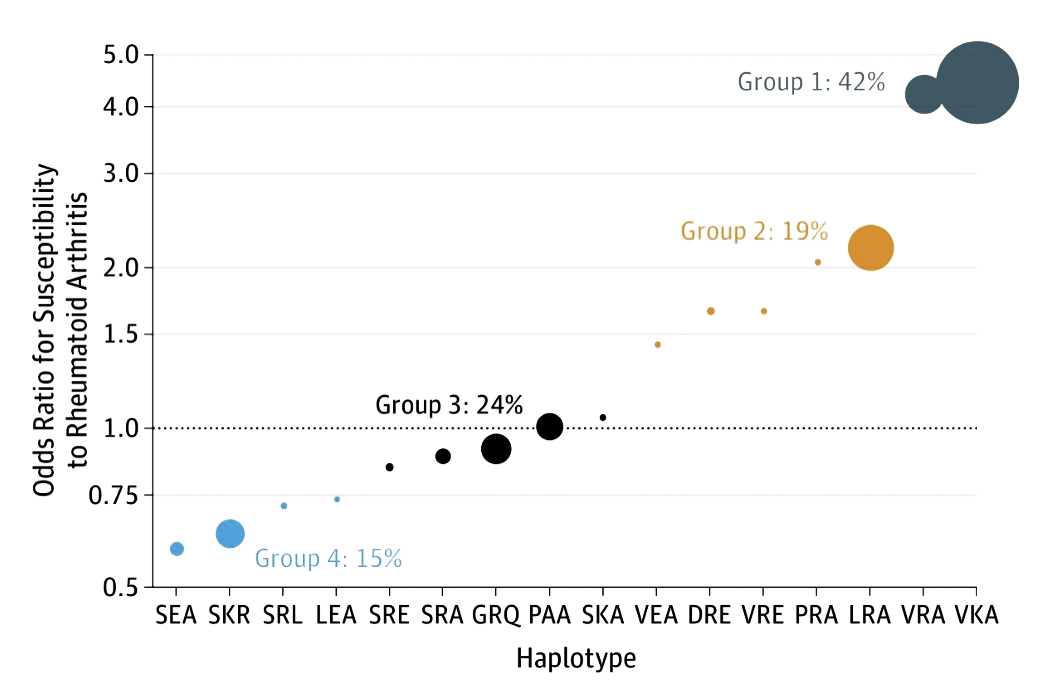 Patients’ stratification based on HLA-DRB1 haplotypes.
Viatte, JAMA, 2015